
In 2026, catfishing is more than a troll using Kylie Jenner’s picture. It’s part of an elaborate scam that causes billions in losses every year.
How dangerous are catfishes, really? Who’s their typical prey, and how do they carry out scams? These are the most crucial 2026 catfishing statistics:
What Counts as Catfishing in 2026?
Catfishing means using a fake identity to deceive someone online. In romance catfishing, that fake identity is used to build trust before asking for something.
- Money, crypto, or gift cards
- Intimate photos
- Personal information or account access
- Emotional control
- Continued private communication
- Help with a fake crisis or fake investment
After the emotional connection is established, fraud, blackmail, harassment, sextortion, identity misuse, or romance scams can happen.
Lauder and March’s 2023 study found that men were more likely to report catfishing behavior (38% of men vs. 23% of women) – this is based on one study, not a global, official estimate.
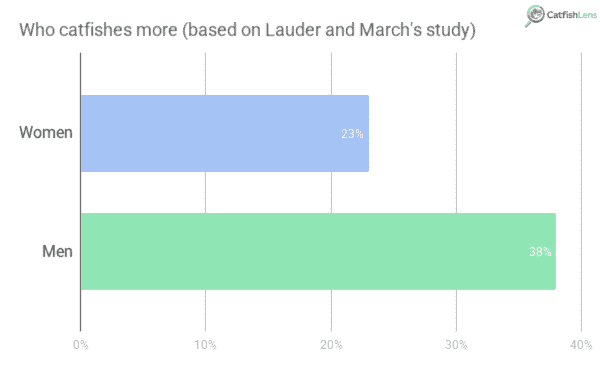
But traits like psychopathy, sadism, and narcissism were stronger predictors of catfishing than gender alone.
Web-based research (156 catfishes and 826 targets) revealed that 55% of perpetrators said they did not feel guilty about the deception.
⚠️ We do not know what percentage of people are catfishing, but exposure to fake and deceptive profiles is clearly common.
How Many People Get Catfished in a Year?
In the U.S., nearly 70,000 people reported romance scams in 2022. And in 2024, the FTC reported 845,806 imposter scams (someone pretending to be a romantic interest, friend, authority figure, or company).
In the UK, 75% of all romance scams originated online in 2024 (4,087 romance scam cases). In 2025, there were 10,784 romance fraud reports.
*The “odds” are hard to pin down because catfishing means different things: seeing/texting a fake profile, emotional manipulation, sending money, or blackmail.
But dating-app data show a consistent pattern:
👉 52% of American users think they have encountered a scammer or catfish on a dating app, as stated by Pew Research Center.
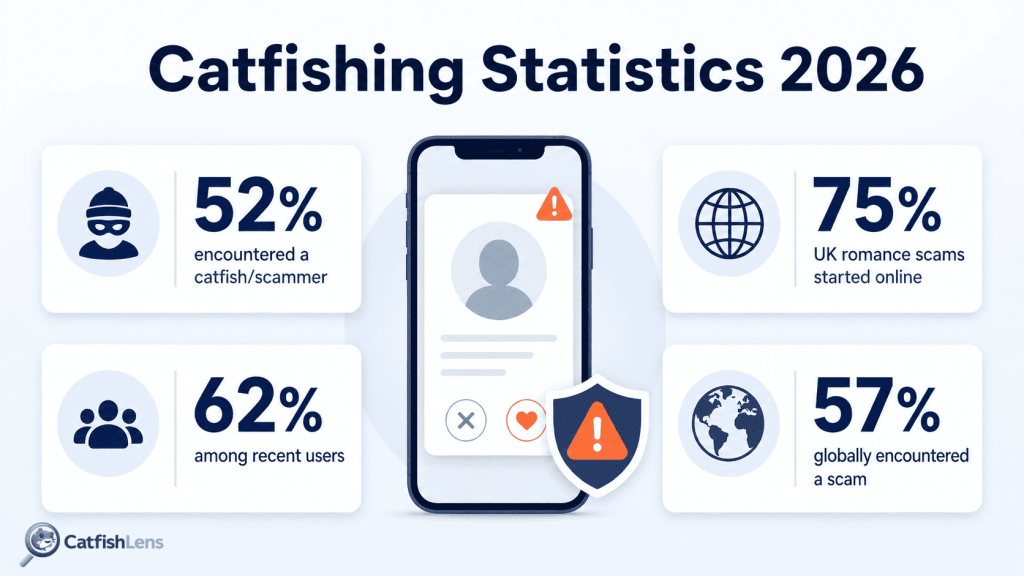
- Among recent dating-app users, that rises to 62%.
- 72% of male dating-app users believe they have seen a catfish/scammer.
- 71% of users say it’s common for people to lie to look more desirable.
- 50% of users think fake scam accounts are very common.
73% of U.S. adults have experienced some kind of online scam or attack, while 38% of fraud reports involved financial loss.
Globally, 57% of adults reported encountering a scam, and 23% said they lost money, according to GASA.
| 62% | Recent dating-app users | Think they have encountered a scammer |
| 72% | Male dating-app users | Male users report the highest scammer exposure |
| 71% | Online daters | Say people try to look more desirable |
| 50% | Online daters | Say fake scam accounts are very common |
Note: the exact number of catfishing victims is unknown, but exposure to fake identities is very real on dating apps like Bumble and social media.
Catfish Victim Demographics and Risk Patterns
According to the FTC’s 2024 Consumer Sentinel data, those aged 20–29 reported losing money in 44% of the cases. For ages 70–79, the figure was 24%. For ages 80+, it was 21%.
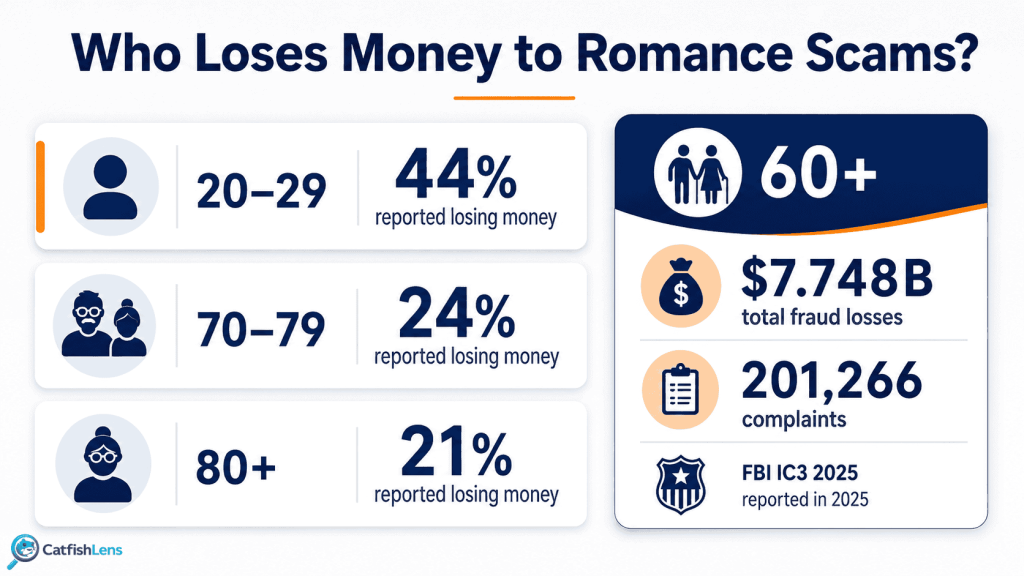
Older adults often lose more money. In 2025, people aged 60+ filed 201,266 complaints and reported $7.748 billion in total fraud losses.
(FBI IC3 2025 Internet Crime Report)
➡️ In the UK, people aged 55 to 74 accounted for almost half of the total value stolen in romance fraud in 2025.
➡️ Men were more likely to get catfished and be asked for money, but women lost more money overall, UK 2025 romance scam findings exposed.
➡️ In Australia, people aged 65+ reported the highest Scamwatch losses in 2024, at A$99.6 million.
➡️ Romance scams were the second-highest-loss scam type for Australians aged 45–54, 55–64, and 65+.
| 44% | U.S. ages 20–29 | Most likely to report losing money |
| $7.748B | U.S. ages 60+ | Highest total fraud losses |
| Almost half | UK ages 55–74 | Share of romance fraud value stolen |
| Men reported more, women lost more | UK romance fraud | Gender split in reports vs. losses |
| A$99.6M | Australia ages 65+ | Highest Scamwatch losses |
Younger people may encounter and report fraud more often, while older adults often face heavier financial losses when targeted.
Statistics on Social Media Catfishing
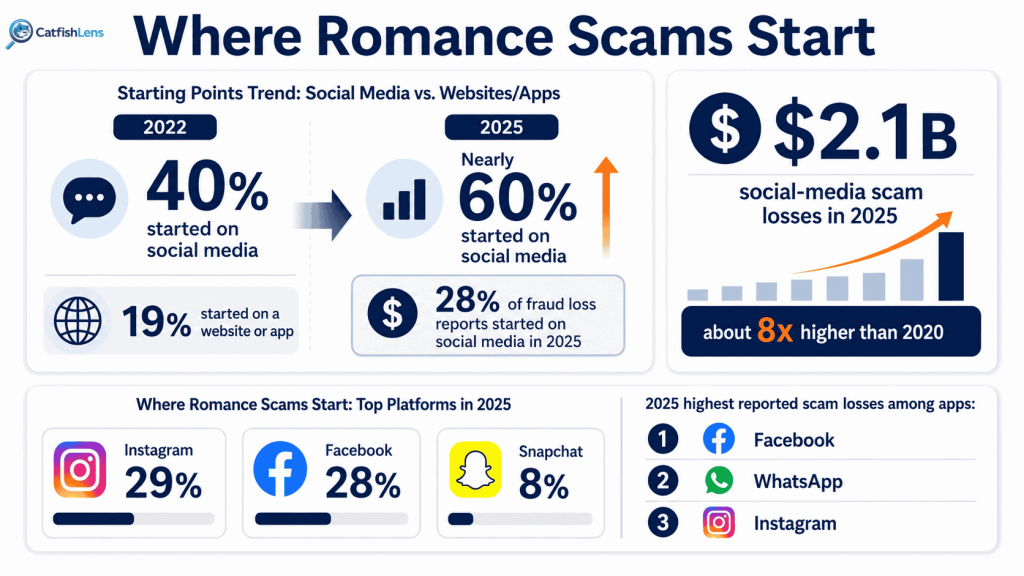
In 2022, 40% of romance scam loss reports started on social media, compared with 19% on a website or app. By 2025, that had grown to nearly 60%, as found by the FTC.
In 2025, 28% of fraud loss reports started on social media. Social-media scam losses reached $2.1 billion that year, about eight times higher than in 2020.
Instagram accounted for 29% of scam reports and Facebook for 28% in 2022. In 2023, 21% of romance scam losses happened on Facebook and Instagram. Snapchat appeared in 8% of the reports.
By 2025, exact percentages were not published, but Facebook had the highest reported scam losses among apps, followed by WhatsApp and Instagram.
A UK review of 60 romance-fraud cases found that 85% began through relationships online. Separately, UK Finance found that 75% of romance scams originated online in 2024.
Australians reported almost 4,000 dating scams in 2019 (31.4% online), with over A$28.6 million lost; the average loss was over A$19,000 (37.5% of reports claim).
Social media produced the highest Scamwatch losses, accounting for over 33% of dating and romance scam losses, or A$9.1 million.
| Platform | No. of reports | Money lost |
| 347 | A$976K | |
| 325 | A$2M+ | |
| Skype | 90 | A$758K |
| Viber | 23 | A$909K |
| 21 | A$130K | |
| Twitter/X | 16 | A$5.8K |
Instagram makes up 8.8% of dating and romance scam reports, while Facebook caused the highest social-media losses, totaling 7.3% of all losses.
The next move is usually a private chat. Many romance scam chats shift to WhatsApp, Telegram, or Google Chat, according to 40% of 2022 reports.
In 2022, 58% of sextortion-style catfishing reports identified social media as the contact method, especially on Instagram and Snapchat.
People aged 18–29 were over six times as likely as people aged 30+ to report sextortion.
How Does Catfishing Happen on Dating Apps?
As mentioned earlier, about half of U.S. online daters believe they have come across a catfish, and many see fake/exaggerated profiles as common.
53% of online daters told Pew Research Center they had come across someone who misrepresented themselves. They lie about age, looks, job, lifestyle, intentions, etc.
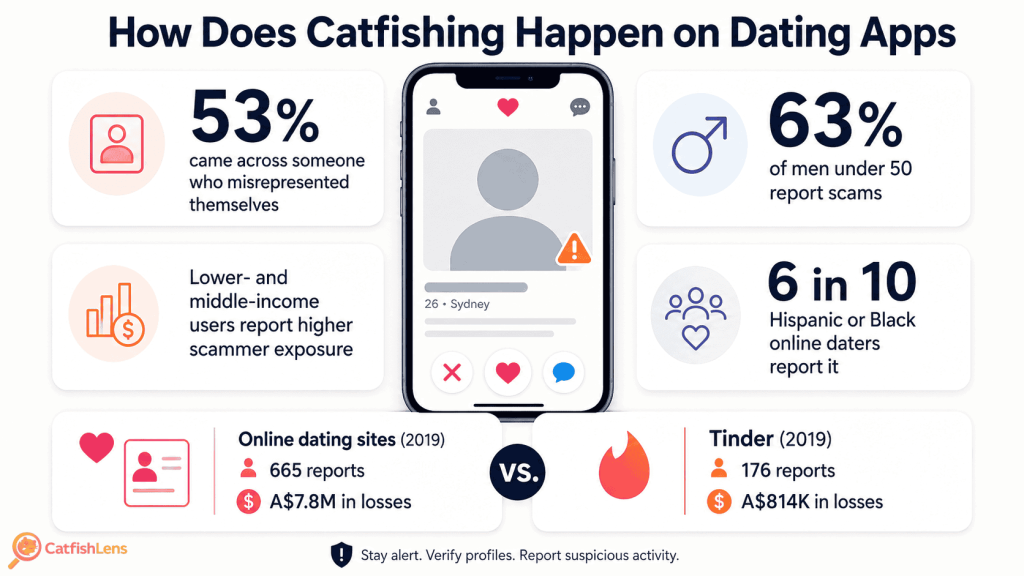
🧓 Men under 50 are especially likely to report scams, at 63%.
💵 Lower- and middle-income users report higher scammer exposure than higher-income users.
🌍 Six-in-ten Hispanic or Black online daters report it, compared with about half of White users.
In 2019, online dating sites generated 665 dating and romance scam reports and more than A$7.8 million in losses, while Tinder generated 176 reports and about A$814,000 in losses (source: Australian Scamwatch).
Tip: If you suspect your online match is a catfish, reverse face search their profile photos and find the real owner using CatfishLens!
Catfishing Types, Tactics, and Red Flags
Scam guidance in 2026 points to the same warning signs: fast emotional bonding, moving the chat to a private platform, and financial requests.
🚩 The most common catfishing red flags include:
| Fishy profiles | Empty and inorganic activity, with no tagged posts |
| Stolen photos | Celebrity or AI-generated photos (they look “flawless”) |
| Love bombing | Catfishes force emotional, romantic connections early on |
| Excuses | They refuse to video call and meet up IRL |
| Inconsistencies | Catfishes constantly switch up their life details |
| Favors | Money, crypto, gifts, medical help, investments, or nudes |
– There are different types of catfishing:
1. Romance catfishing: pretending to fall in love to gain trust.
2. Financial catfishing: catfishes who aim for financial gain
3. Social media catfish: fake profiles that manipulate, impersonate, or scam.
4. Dating app catfishing: misleading Tinder profiles used to attract matches.
5. Sextortion catfishing: using victims’ nudes for blackmail.
6. Identity theft catfishing: using a real person’s name, photos, and job.
7. AI catfishes: using AI-generated images, scripts, voices, or videos.
8. Pig butchering: emotionally manipulating a victim to send money.
9. Harassment or revenge: these catfishes embarrass, stalk, threaten, or damage someone.
🎣 What is the difference between Catfishing and Phishing?
Catfishing uses a fake identity and emotional manipulation, whereas Phishing means pretending to be a person or business to steal sensitive info.
The common “4 P’s” framework is Pretend, Problem, Pressure, Pay.
AI Catfishing and Deepfakes: The 2026 Problem
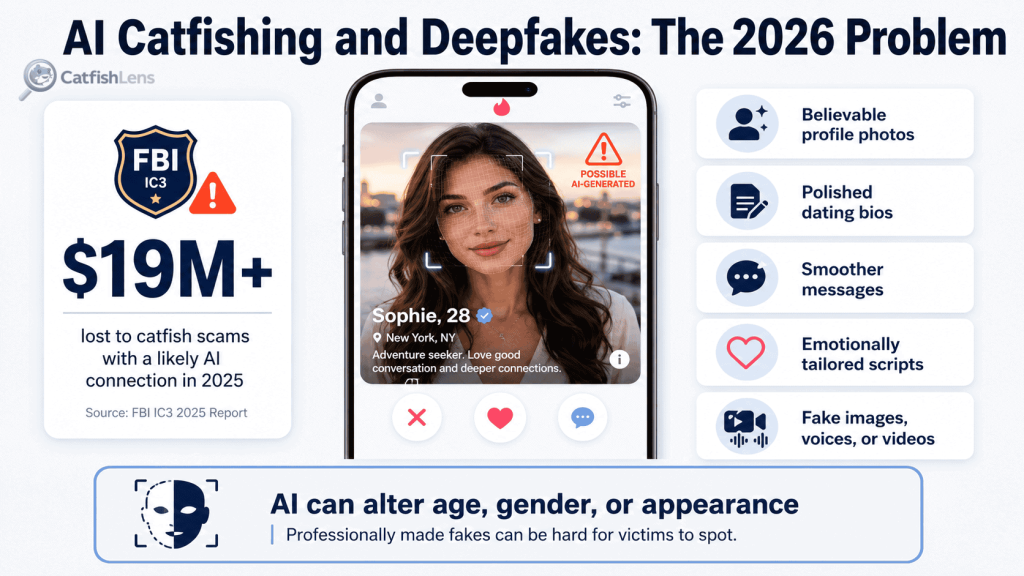
The FBI says that AI has made catfishing easier. In 2025, victims lost over $19 million to catfish scams with a likely AI connection (fake profiles and AI scripts).
Investigators have also reported increased use of AI-generated images and messages in romance fraud. AI can help scammers create:
- Believable profile photos
- Polished dating bios
- Smoother messages
- Emotionally tailored scripts
- Fake images, voices, or videos
On that note, AI helps catfishes modify their appearance (e.g., chadfishing), gender, or age; victims may not be able to tell they’re being catfished.
Catfish Scam Money Loss & Emotional Toll
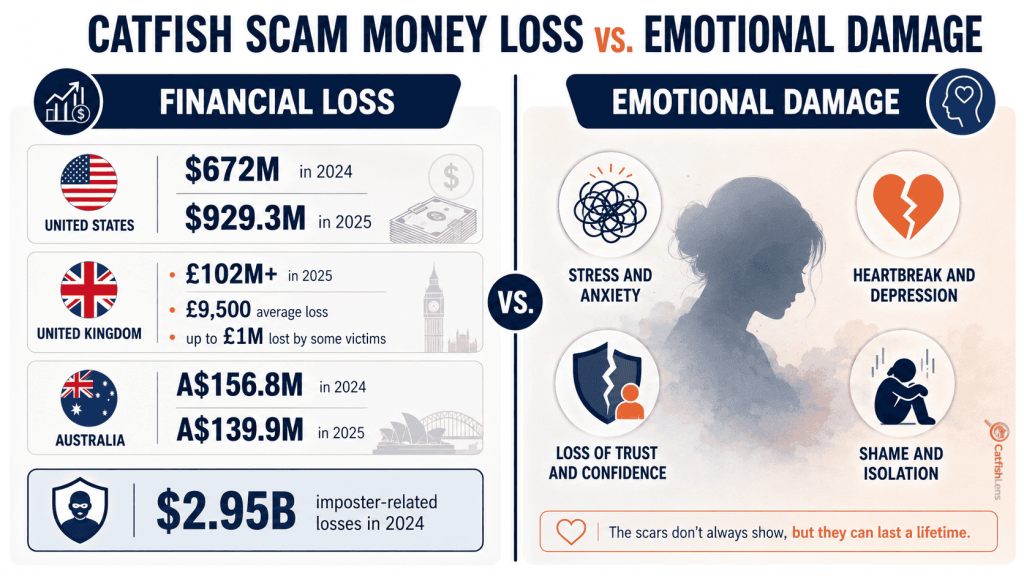
In the U.S., reported scam losses reached $672 million in 2024 and $929.3 million in 2025, according to the FBI. 2024 imposter-related incidents caused $2.95 billion in losses.
In the UK, romance fraud losses passed £102 million in 2025. The average individual loss was £9,500, and some single victims lost as much as £1 million.
UK Finance separately recorded £30.5 million lost through romance scam cases in 2024.
In Australia, romance scam losses reached A$156.8 million in 2024 and A$139.9 million in 2025.
| Money loss due to romance scams (2025) | Country |
|---|---|
| $929.3M | U.S. |
| £102M+ | UK |
| A$139.9M | Australia |
Important: catfishing is not a quick “send me money” scam anymore. It blends romance fraud with long-term grooming, fake investments, and crypto scams.
Research on catfishing suggests the victims’ fallout can be severe, especially when the scam involves emotional grooming, financial loss, or identity abuse.
- Trust issues and depression
- Lingering attachment
- Anger and embarrassment
- Fear of dating or meeting people online again
– What about the person whose photos were stolen? 🤔
If someone uses a real person’s face, name, or social media profile to catfish, that person can be dragged into trouble they had nothing to do with.
So the damage is not just financial. Catfishing can hurt someone’s privacy, reputation, confidence, relationships, and ability to trust.
P.S. Catfishing Statistics Are Probably Underreported
First, catfishing is not recorded consistently. One case may be counted as romance fraud, and another as an imposter scam.
Different countries, agencies, and platforms use different catfishing categories: sextortion, blackmail, harassment, or identity theft.
Second, many victims never report it because they feel ashamed and blame themselves; they may even still have feelings for the scammer.
Some victims do not realize they are being catfished until much later, and fear that their intimate images, messages, or details will be exposed.
- Only 4.8% of people who experienced mass-market consumer fraud complained to a government entity or the Better Business Bureau.
That means official numbers should be treated as minimum confirmed counts, not the full picture.
Sources:
- https://www.esafety.gov.au/key-topics/staying-safe/catfishing
- https://www.esafety.gov.au/young-people/catfishing
- https://www.sciencedirect.com/science/article/abs/pii/S0747563222004198
- https://www.researchgate.net
- https://www.ftc.gov
- https://www.ftc.gov/system/files/ftc_gov/pdf/csn-annual-data-book-2024.pdf
- https://www.pewresearch.org
- https://www.pewresearch.org-online-scams-and-attacks-in-america-today/
- https://www.pewresearch.org-the-virtues-and-downsides-of-online-dating/
- https://gasa.org
- https://www.ftc.gov-reported-losses-scams-social-media-eight-times-higher
- https://www.ftc.gov-social-media-golden-goose-scammers
- https://www.ftc.gov-reports-romance-scams-hit-record-highs-2021
- https://www.ukfinance.org.uk-annual-fraud-report-2025
- https://www.theguardian.com
- https://www.accc.gov.au
- https://www.ic3.gov/AnnualReport/Reports/2024_IC3Report.pdf
- https://www.ic3.gov/AnnualReport/Reports/2025_IC3Report.pdf
- https://www.cityoflondon.police.uk
- https://www.scamwatch.gov.au
- https://consumeraffairs.nt.gov.au
- https://journals.sagepub.com/doi/10.1177/1748895815603773
- https://www.fbi.gov-cryptocurrency-and-ai-scams-bilk-americans-of-billions
- https://www.interpol.int
- https://csrc.nist.gov/glossary/term/phishing
- https://eprints.bournemouth.ac.uk
 English
  German
  French
  Dutch
Dutch  Spanish
  Portuguese
Leave a Reply