
If you’re a Hinge user, chances are you’ve come across a catfish at least once. I know I did.
In this article, I’ll talk about my journey: how I reverse image searched my Hinge match and found out he was catfishing me!
*Upload a Hinge profile photo and get instant, accurate results:
What Types of Hinge Catfishes Are There?
I’ve noticed that there are mainly 3 types of catfishes on Hinge: scammers, bots, and “kittenfishers”.
💵 Romance scammers aim to get money out of victims on Hinge through lies about affection, financial struggles, or health issues.
– “I have medical bills to pay. Do you think you can help me? I’m telling you this only because we have something special.”
🤖 Hinge bots repeat the same speech. They’re sometimes programmed to install viruses, spam links, and nonsensical speech.
💄 Kittenfishers slightly change parts of their appearance or life to seem more appealing. They might even pass Hinge’s Face Check verification.
For all kinds of catfishing, the solution is simple: reverse image search. Here’s how I found out my Hinge match was a catfish, in 4 quick steps:
1. Screenshot Their Hinge Profile Photo
You can’t directly save your match’s selfie from Hinge to your device, so take a screenshot instead!
I screenshotted a high-quality photo of my match and cropped it so that the face is centered (if you have a zoomed-in face photo, you can skip this step).
The goal is for the face to be as clear as possible because that is what works best with face recognition tools.
🚫 For maximum performance, avoid the following.
- No group shots
- No pixelated images
- No beauty filters or excessive makeup
- No photos where the face is covered by hair or glasses
- No unnatural lighting (e.g., black & white)
The photo I reverse-searched looked something like this. 👇
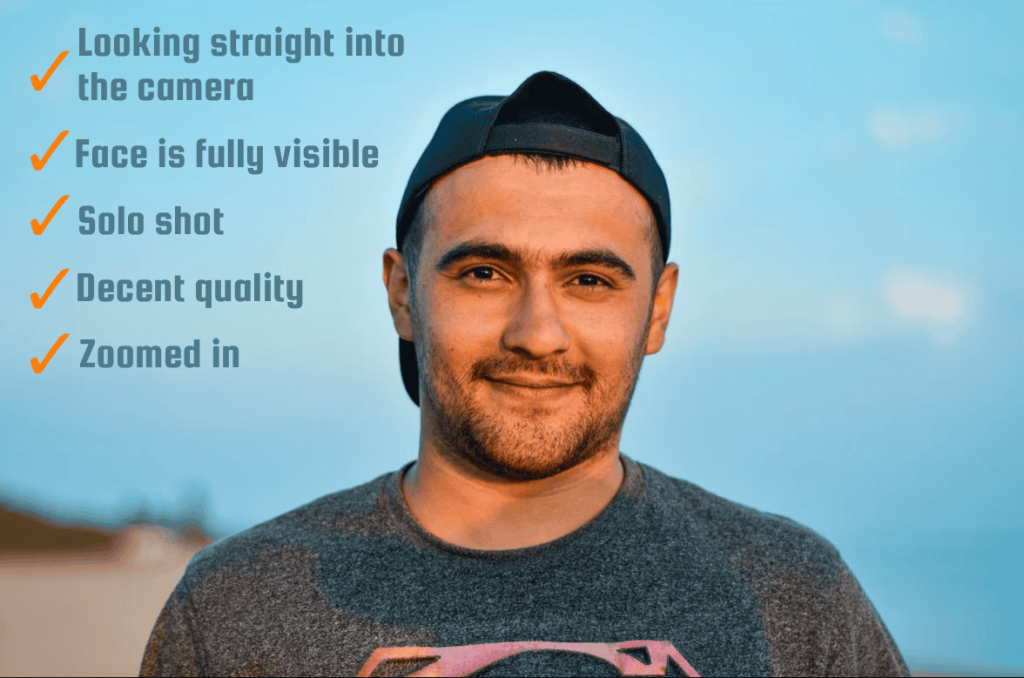
*For the sake of my match’s privacy, I won’t show you the actual image.
2. Try Your Luck With Basic Reverse Image Searching
My first stop was a basic photo lookup tool because I didn’t want to rush into paying if I could do it for free. Try your luck! Here are my suggestions:
🔎 Search Engines (Google, Bing, or Yandex)
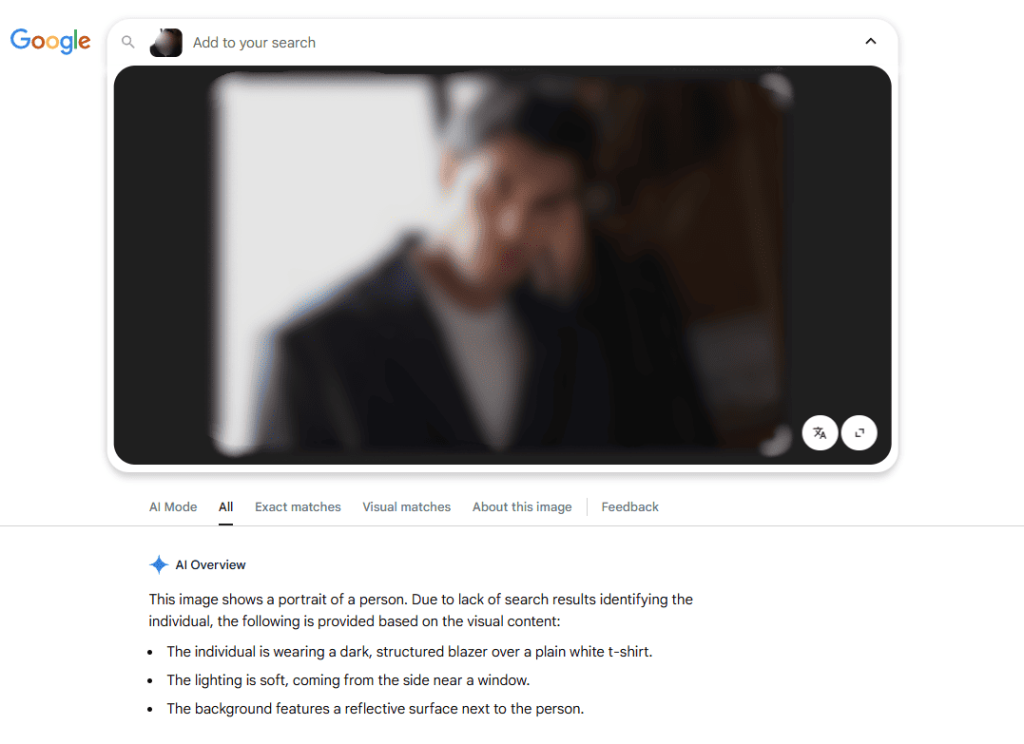
The first tool I tried was Google. Simply open the Google browser, press the camera icon on the search bar, and upload the photo.
Google Results: Zero. Gave a vague image description.
🆓 Free Tools (TinEye)
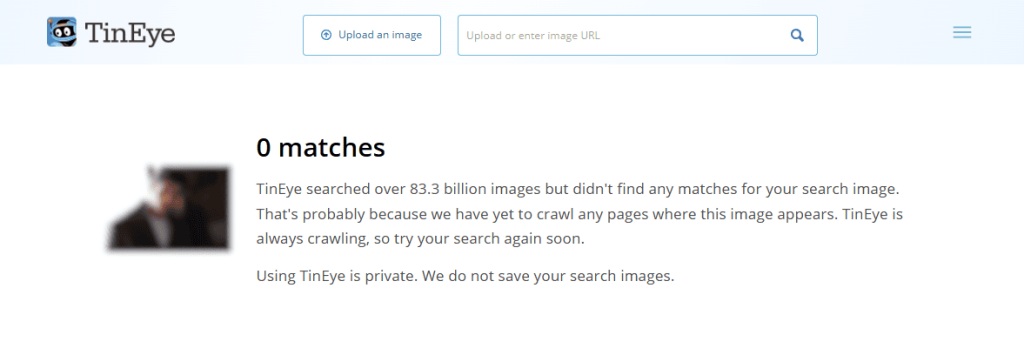
After the Google bust, I thought I’d give free reverse photo searching another go on TinEye. Go to the TinEye site, upload the selfie, and press search.
TinEye Results: Again, zero. Didn’t even try.
⚠️ Search engines and other free methods are more effective for catfishes using celebrity photos because they scan popular sources.
My results came up empty because my Hinge match was using a random guy’s photos. Free tools don’t use true face recognition technology, which is what helps identify non–famous people’s photos.
3. Use a Reverse Face Recognition Search Tool
Still no clue as to who the man I met on Hinge was. I was starting to like him, but I couldn’t shake the feeling he was BS-ing me, so I turned to CatfishLens.
CatfishLens is a face recognition tool that specializes in catching catfishes. It claims to work with AI-generated faces, even if they’re blurry or edited.
After reading the positive reviews, I said screw it and paid $5 since I was getting desperate to know if my Hinge match was real or not.
✅ CatfishLens Results: The man’s real identity & other accounts using the same photos (more on this in the next section).
As opposed to basic tools, CatfishLens is better at identifying Hinge profiles because it scans public sources in depth:
- It has advanced face recognition
- Identifies both popular AND random faces
- It’s budget-friendly
- No forced subscriptions & no locked previews
4. Read the Reverse Photo Search Results
Luckily for me, the CatfishLens report was easy to understand because the results, risk signals, and image sources were neatly organized.
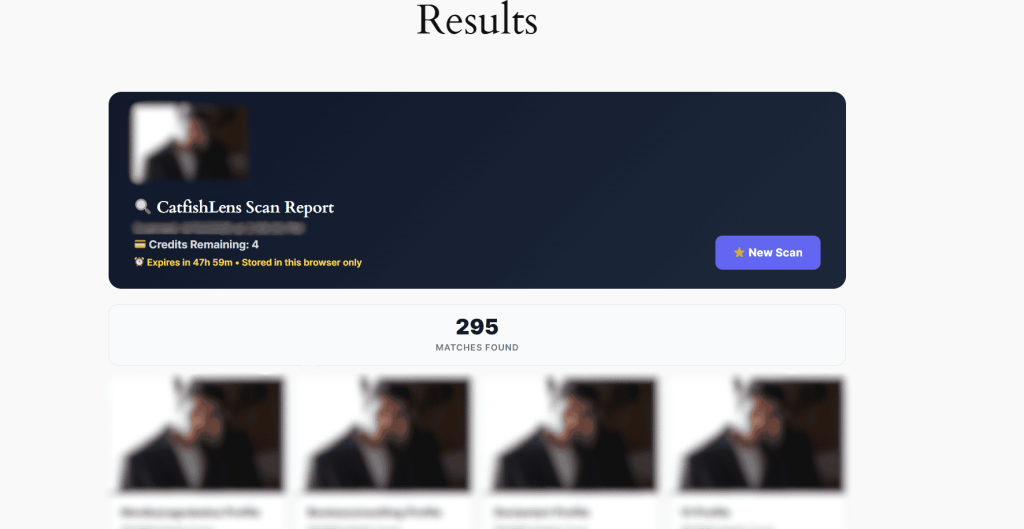
It was up to me to decide if my Hinge match was bogus. It was overwhelming for an amateur, but I boiled the whole process down to 3 steps: ⬇️
1. Related Image Analysis.
CatfishLens compiles related images. Analyze them to see if your Hinge match has digitally altered their selfies or if they’re using old ones.
2. Social Media Investigation.
The report included my match’s socials (Instagram) & dating apps like Tinder. I opened the links and saw that the image was being mass-used by different people.
3. Consistency Assessment.
Look at whether the pictures are being used by the same person and if their personal details match what you’ve been told on Hinge.
Conclusion: My Hinge match was catfishing as a local European model who has a girlfriend…ouch. I hope he doesn’t get in trouble.
Signs You’re Talking to a Hinge Catfish
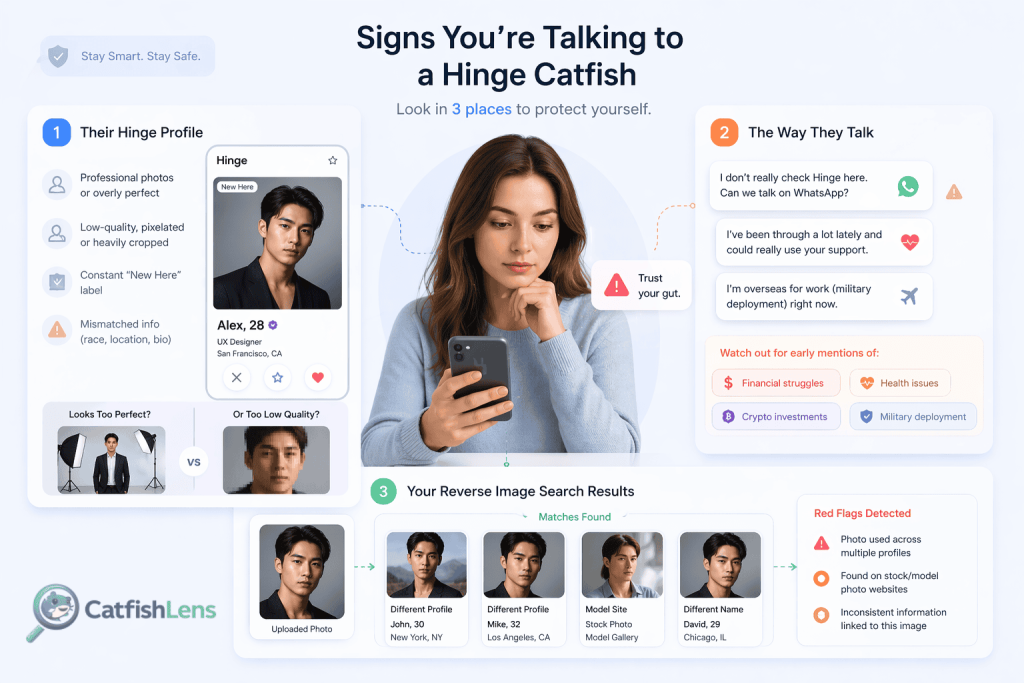
Hinge catfishes behave weirdly, but I’ve learned my lesson! Now I can spot a catfish from the get-go. You need to look in 3 places:
📱 Their Hinge Profile:
Hinge catfishes use professional pictures: full-blown photoshoots with studio lighting. They might have stolen attractive people’s photos, usually models.
Alternatively, their photos may be low-quality (pixelated or cropped funny), which happens when you constantly save and reupload photos online.
Extra Signs: A constant “New Here” label on Hinge & mismatched info. E.g., race is set to White on their profile, yet they use photos of an Asian model.
✏️ The Way They Talk:
Human catfishes avoid dates and real-time photos, but they will urge you to move your chat to another app because Hinge cracks down on fishy users.
If their goal is money, these Hinge catfishes will try to force an emotional connection very early on. Watch out for these topics:
- Financial struggles
- Health issues and other emergencies
- Crypto investments
- Military deployment, etc.
📄 Your Reverse Image Search Results:
If the same photo is used by different people, appears on stock/model sites, or is linked to inconsistent info, then you’re talking to a catfish on Hinge.
FAQ: Common Hinge Reverse Image Search Issues
1. Why did my reverse image search report come up empty?
The image might come from a private source. It’s also possible the photo is new or AI-generated. Try a different tool or photo (with the face fully visible).
2. Am I safe if my Hinge match is verified?
Not necessarily. Hinge’s Face Check scan ensures your match’s photos are their own, but this step can be faked through specific programs.
3. How do I trick a Hinge catfish?
The best offense is defense. Don’t reveal any personal details, like your credit card. Push for an IRL date and ask your match to send candid shots.
4. What are the signs of a Hinge catfish?
“Perfect” photos and money topics are the most common signs. Also, scan their socials: if they’re empty or inorganic, your match is probably a catfish.
5. What is CatfishLens? Is it better than basic, free engines?
CatfishLens is a reverse image search tool, and it’s better than basic tools like Google and TinEye because it uses powerful face recognition AI.
 English
  German
  French
  Dutch
Dutch  Spanish
  Portuguese
Leave a Reply